Showing posts with label Vocabulary. Show all posts
Showing posts with label Vocabulary. Show all posts
18 Nov 2019

14 Oct 2015
The power of adjectives in descriptions: cities
Hi there!
These days we've been talking about cities and we've learnt some very useful vocabulary to describe them. Below I include some of these words (remember to check their pronunciation!). Can you add any other?

Now, today I didn't want to focus solely on these adjectives, but rather highlight the effect and crucial importance that adjectives have in our writing and speech: being able to be specific and choose the right word adds value to our language, and colour to our descriptions.
Have a look at the following text about Mexico:
Mexico City is Mexico's capital city and one of the most important political, cultural, educational and financial centres in North America. With a GDP of $411 billion US dollars in 2012, it is ranked as the eighth richest city in the world. Settling on an altitude of more than 2,000 metres, tourists are instantly enamoured by the city's glamour, cultural heritage and contemporary development. Every corner of the city is sprinkled with stories to tell of famous personalities and ancient tribes. While the Aztecs discovered and gave the city its culture and heritage, the Spanish revamped and added their touch. Today, the cultural amalgamation is mirrored in every landmark of Mexico City, be it the Templo Mayor, El Zócalo square, Catedral Metropolitana or Frida Kahlo museum.
- What feeling do you have when you finish reading?
- What kind of adjectives are used the most: positive, negative or neutral?
- How does this affect the impact of the article?

(Note: No offence intended to the people in Middlesbrough. It is deliberately wildly exaggerated to show the power of negative adjectives in an English text.)
The text is evidently extremely negative, something which is mainly achieved via the adjectives used. Now, do the following:
- Highlight all the negative adjectives/expressions.
- Replace them with some more positive ones.
- When you have finished, check the impact the text has on the reader now. Has it changed?
This exercise would be a very good opportunity to start using an antonyms dictionary. Check the entry "Back with dictionaries again! Enrich your vocabulary fast and easy" to learn how to do it!

2 Oct 2015
Back with dictionaries again! Enrich your vocabulary fast and easy
Several posts have already been published in this blog about dictionaries ("There is life outside word reference!"; "Using monolingual and collocations dictionaries"). Today we're going to focus on yet a different type of dictionaries: dictionaries of synonyms and antonyms. Have you ever used them??
To start with, a synonym is a word that has a similar or the same meaning as another one in the language, whereas an antonym is a word that has an opposite meaning. I include some examples below:
Examples of synonyms:

Some more advanced examples include:
Examples of antonymsBeautiful: Attractive, Pretty, Lovely, Stunning
Fair: Just, Objective, Impartial, Unbiased
Funny: Humorous, Comical, Hilarious, Hysterical
Happy: Content, Joyful, Mirthful, Upbeat
Hardworking: Diligent, Determined, Industrious, Enterprising
Honest: Honorable, Fair, Sincere, Trustworthy
Intelligent: Smart, Bright, Brilliant, Sharp
Introverted: Shy, Bashful, Quiet, Withdrawn
Kind:Thoughtful, Considerate, Amiable, Gracious
Outgoing: Friendly, Sociable, Warm, Extroverted
Working on our synonyms and antonyms will incredibly help us to enrich our vocabulary. (I also talked about this in an earlier post: "learn how to be more descriptive!"). But how can you do that? Well, there are many ways, from writing lists in your notebook, to designing flashcards or categorizing your vocabulary. But today we're only going to focus on one: dictionaries of synonyms and antonyms.
There are two main dictionaries of this sort online:
I personally prefer the second one, and here I'm going to show you an example of how it works. Extremely useful, and dead easy, you'll see!!
The homepage looks like this: (make sure it says "synonyms" on the left)

As an example I have introduced the word "sad". To start with, something very useful is that the words are coloured according to their relevance/frequency, as you can see below:

More than that, you can also activate the options "common" or "informal" on the right, so that the corresponding words are highlighted. This is extremely important, since when you learn a new word, you should also know if you should use it in formal or informal contexts. These differences of register are essential for advanced students.


If you scroll down a bit more, we find the antonyms. Again, they're highlighted according to their relevance and you can activate the options "common" and "informal".

Awesome, huh? :)
Well, now you just have to start using it!


If you scroll down a bit more, we find the antonyms. Again, they're highlighted according to their relevance and you can activate the options "common" and "informal".

Awesome, huh? :)
Well, now you just have to start using it!
24 Nov 2014
Learn how to be more descriptive!
Hi there!
I'm sure you've all heard your teachers asking you to use more complex vocabulary, and avoid using words like nice, good, say, ask, etc. Indeed, as we advance in our language learning, we have to be more specific and avoid 'empty words' like the ones I mentioned before.
How can we do that? A very good idea is to compile a list of synonym words and include some linguistic variation when we talk/write. Here I post an example:
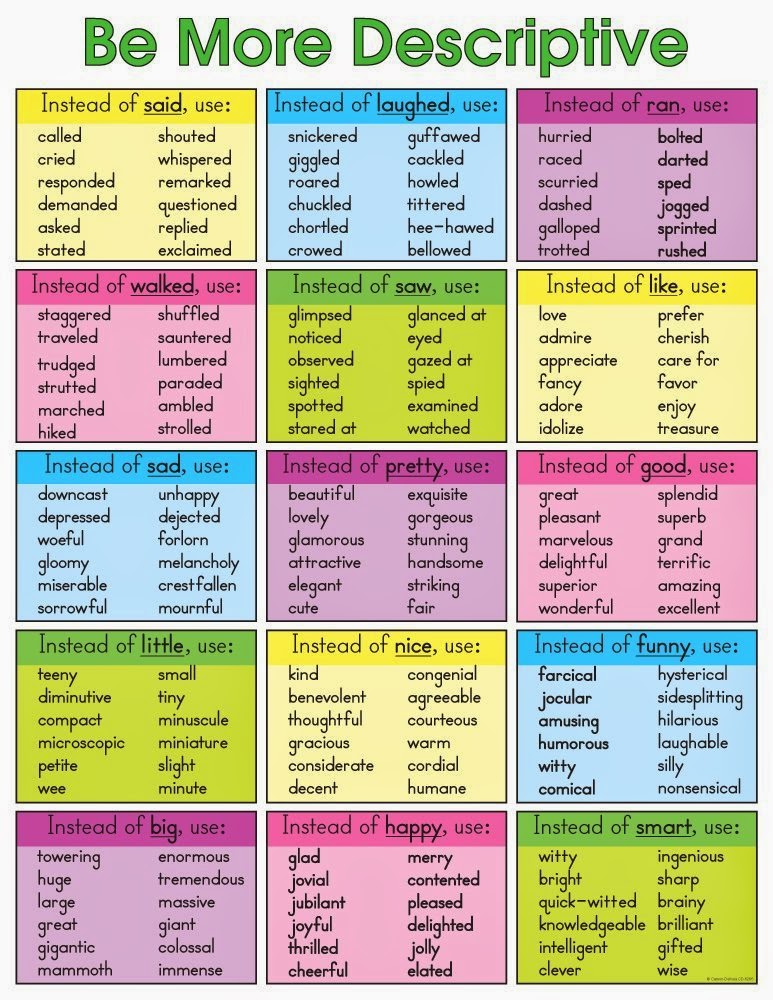
My suggestion is that, for every word, you choose two or three synonyms that you've never used before. Circle/underline them and make an effort to use them in the next few weeks. That way you'll enrich your vocabulary little by little!
Let me know how it goes! :)
17 Nov 2014
"Bed and breakfast", "fish and chips" and other binomial expressions
A binomial is a combination of two words, normally linked by a conjunction (and or or). Their order is almost always fixed, that is, they are irreversible.
English is extremely fond of binomials, and when I say "extremely", I do mean "extremely"! If you want to check for yourselves, have a look at this list of binomials, with their corresponding meanings. You'll be surprised!
Do these ones ring a bell??
Do these ones ring a bell??

Some other common ones include:

If you want to know a few more, check the video below: "10 common binomial expressions in English". She speaks rather slowly, but her explanations and examples are very accurate!
Finally, for more advanced learners, here I post a handout with some more complex ones. See if you can complete the exercises! (The answers are at the end, as usual!)
If you want to know a few more, check the video below: "10 common binomial expressions in English". She speaks rather slowly, but her explanations and examples are very accurate!
Finally, for more advanced learners, here I post a handout with some more complex ones. See if you can complete the exercises! (The answers are at the end, as usual!)
Now, the best way to remember binomials, as every other item of vocabulary, is to place them in context. Choose your favourite ones and post a few examples in the comments below!
10 Nov 2014
Learn your A B C !
 Hi!
Hi!
One of the first things you learn in a new language is the alphabet! Many words are new, and your teacher will spell them to you. You will also have to spell you name, and many more things!
The best way to learn the alphabet is to find a catchy song and learn it! Here you have a very good video with famous people singing the alphabet! I hope it helps you!
5 Nov 2014
A tip to study phrasal verbs
Hi everyone,
On Tuesday we worked with phrasal verbs. You always complain that they are very difficult to memorize and to remember, and... it's true...! However, there are some tips that can help you to learn them better and more efficiently!
Below I post a mind-map that can improve your learning of phrasal verbs, especially if you have visual/photographic memory. Also, you can revise a lot of phrasal verbs with just one look!

I know these phrasal verbs are rather easy, but what I want you to see is a possible organisation for the new phrasal verbs you learn.
I know these phrasal verbs are rather easy, but what I want you to see is a possible organisation for the new phrasal verbs you learn.
Remember that the way you organise your vocabulary is as important as the time you spend studying it!
29 Oct 2014
Job or work?
Hi everyone,
When we talk about jobs and professions you always have the same doubt... is it job or work??
Well, I hope this explanation helps you!

In BBC Learning English there is a section called "Ask about English". There an Italian student called Giuliana asks the same question: what's the difference between work and job? Click to listen to Gareth Rees answer; you have the transcription at the bottom of the page!

26 Oct 2014
Fruit and vegetables; dictation exercise on food
Hello guys!

Today I post the entry about food! Here you have some vocabulary with some basic food, drinks, vegetables and fruit!


(Taken from www.eslgold.com)
If you want to practise the pronunciation of different fruits, watch this video. Listen and repeat!
Check this website for some exercises on food. There are many! Finally, you can also do a dictation exercise about food!
22 Oct 2014
Love at first sight!
Hello!
I hope you're having a nice day! :) Today we're going to talk about love and relationships! Do you know any expressions? Below you have many! (Remember that "sb" means someone/somebody).

Read the expressions and check a dictionary (for example, www.wordreference.com) if there is any word you don't know. Be very careful with the pronunciation of engaged; listen to it in the dictionary and repeat :)
Now, imagine a "normal" relationship. In what order would things happen?
I would suggest something like this...!
You meet someone for the first time. It was love at first sight! Then you go on a date. You like each other a lot and so you start going out together. After some time, you fall in love, but then you can have arguments and you finally break up... :( However, you get back together again, and you get engaged! You get married and you are happy ever after!
Is your story similar to mine? Please, share it with us in a comment below! :)
Finally, here you have a listening about a girl going on her first date. Click here www.esl-lab.com and listen to it twice; try to answer the questions and then check the transcription. You also have the explanation of some new vocabulary!
8 Oct 2014
Vocabulary "in town"; giving directions
Good afternoon!
Last week we talked about monuments and we learnt some vocabulary related with places in a town. Here you have some of them:

Then we worked with a map and we learnt how to give directions.

Can you remember other expressions? Revise them and their pronunciation with this exercise about giving directions. I'm sure you'll like it!
Then do your own dialogue here!

10 Oct 2013
Revision of tenses; personality adjectives; relationships
Hi everyone!
Here you have the first entry of the year! I'll regularly post a summary of what we've done in class but, most importantly, I'll also post extra material to consolidate and to expand what we do in the lessons.
We've already advanced quite a lot and are almost finishing Unit 1! These days we've been revising tenses, question formation and auxiliaries. As for vocabulary, we've talked about relationships and also personality.
If you want to continue revising English tenses, try the following exercises online:
Read more...
Here you have the first entry of the year! I'll regularly post a summary of what we've done in class but, most importantly, I'll also post extra material to consolidate and to expand what we do in the lessons.
We've already advanced quite a lot and are almost finishing Unit 1! These days we've been revising tenses, question formation and auxiliaries. As for vocabulary, we've talked about relationships and also personality.
If you want to continue revising English tenses, try the following exercises online:
- Revision of tenses 1: here you have exercises with pairs of tenses (present simple vs. present continuous; past simple vs. past continuous; past simple vs. past perfect, etc).
- Revision of tenses 2: here you have a gapped text which combines all tenses.
- Revision of tenses 3: here you have gapped sentences which combine all tenses.
11 Feb 2013
Negative prefixes; why men & women can't be friends
Hi everyone,
On Wednesday we worked with negative prefixes (prefixes to form opposite words). These prefixes can be a bit difficult because there is no rule that tells us which prefix we have to use. For example, is it inexpensive or inexpensive?
That means that we have to learn them by heart...!
Here you have the most common negative prefixes, with some examples:
Dis-

Un-

In-

Il- (always used with words that begin with <l>)

Im- (always used with words that begin with <p>)

Ir- (always used with words that begin with <r>)

You can revise this a little bit more on this link from BBC World Service. If what you want is practise, here you have a matching exercise and a multiple choice exercise. (Note that the adjective "satisfied" can have to opposites: "unsatisfied" and "dissatisfied").
That means that we have to learn them by heart...!
Here you have the most common negative prefixes, with some examples:
Dis-
Un-
In-
Il- (always used with words that begin with <l>)
Im- (always used with words that begin with <p>)
Ir- (always used with words that begin with <r>)
You can revise this a little bit more on this link from BBC World Service. If what you want is practise, here you have a matching exercise and a multiple choice exercise. (Note that the adjective "satisfied" can have to opposites: "unsatisfied" and "dissatisfied").
Now, changing topic...! The day we saw negative prefixes in class we also discussed some issues about family and friends, and someone asked if you believed that boys and girls could be friends, and just friends.
Well, I've found a video recorded at Utah State University about this topic ("Why men and women cannot be friends"). It's in English with subtitles in Spanish, so check it out! I'm sure you'll find it very funny :)
Well, I've found a video recorded at Utah State University about this topic ("Why men and women cannot be friends"). It's in English with subtitles in Spanish, so check it out! I'm sure you'll find it very funny :)
3 Nov 2012
Subject questions; jobs; free time
Hi again!
In this entry I'm going to post some information to revise Unit 1, and then I'll do the same with Unit 2.
At the beginning of the course we did several activities to know each other (some of you met for the first time!), and in the third week you did your first oral presentations. In groups of 3, you talked about someone important from an English speaking country. Thank you once again for your truly great effort :)
Below (abajo) you have a brief summary of the main grammar and vocabulary we have seen in the unit, so that you can revise at home and do some activities on-line:
Read more...
In this entry I'm going to post some information to revise Unit 1, and then I'll do the same with Unit 2.
At the beginning of the course we did several activities to know each other (some of you met for the first time!), and in the third week you did your first oral presentations. In groups of 3, you talked about someone important from an English speaking country. Thank you once again for your truly great effort :)
Below (abajo) you have a brief summary of the main grammar and vocabulary we have seen in the unit, so that you can revise at home and do some activities on-line:
5 May 2012
Conditionals; crime; Jack the Ripper
Hi everyone!
I hope your weekend is off to a good start (nice expression to learn!), although the weather is absolutely miserable!! Let's hope this howling wind goes away soon!
Last week we corrected the unit about "The Natural World". It's a lot of vocabulary, I know, but, remember, take things calmly: sit down, select the words you don't know, copy them in your notebook and check them regularly.
Read more...
I hope your weekend is off to a good start (nice expression to learn!), although the weather is absolutely miserable!! Let's hope this howling wind goes away soon!
Last week we corrected the unit about "The Natural World". It's a lot of vocabulary, I know, but, remember, take things calmly: sit down, select the words you don't know, copy them in your notebook and check them regularly.
17 Feb 2012
Ways to look; "Falling slowly" (song)
Hello everyone!
Last week we did an interesting photocopy with idioms of comparison (e.g. as fresh as a daisy; as deaf as a post; as blind as a bat, as hard as nails, etc.). Make sure you revise this vocabulary!
We also did a little game in pairs to revise some of the phrasal verbs we have seen so far. As a word of advice, have a separate section for phrasal verbs in your notebook. Apart from the translation (if you use translations), try to think of another synonym verb (e.g. give in - surrender) and always, always include a example to see the phrasal verb in context.
 We also continued with the book and corrected the exercises on pages 68 and 69. The one about "ways to look" was a little complicated, so I gave you a handout with their explanations.

Read more...
Last week we did an interesting photocopy with idioms of comparison (e.g. as fresh as a daisy; as deaf as a post; as blind as a bat, as hard as nails, etc.). Make sure you revise this vocabulary!
We also did a little game in pairs to revise some of the phrasal verbs we have seen so far. As a word of advice, have a separate section for phrasal verbs in your notebook. Apart from the translation (if you use translations), try to think of another synonym verb (e.g. give in - surrender) and always, always include a example to see the phrasal verb in context.
 We also continued with the book and corrected the exercises on pages 68 and 69. The one about "ways to look" was a little complicated, so I gave you a handout with their explanations.
30 Jan 2012
Planets; "Imagine", by John Lennon
Good morning everyone!
Last Monday we started with an activity called: "Are you telling the truth'?" You worked in pairs and we learnt interesting vocabulary like: Oh, you're lying! You're not telling the truth, are you? Some of your stories were really good, and we discovered we had some celebrities in class!
After that, we corrected the photocopy about will and be going to and we learnt the pronunciation of the contracted form 'll. Also, remember the difference between want (ᴅ) and won't (əʊ)
Finally, we listened to the song "Imagine", by John Lennon. Here you have the original version:
Read more...
Last Monday we started with an activity called: "Are you telling the truth'?" You worked in pairs and we learnt interesting vocabulary like: Oh, you're lying! You're not telling the truth, are you? Some of your stories were really good, and we discovered we had some celebrities in class!
After that, we corrected the photocopy about will and be going to and we learnt the pronunciation of the contracted form 'll. Also, remember the difference between want (ᴅ) and won't (əʊ)
Finally, we listened to the song "Imagine", by John Lennon. Here you have the original version:
"Invictus"; Events and celebrations
Good morning everyone!
Last week we continued with your oral presentations, which were incredibly well-prepared and enjoyable to listen to. Thank you once again for your hard work.
 In Avanzado 1 A Luisa talked about South Africa, and I couldn't help but think about the 2009 film Invictus, which relates South Africa's story in the last days of the Apartheid, with Nelson Mandela becoming its president after gaining freedom from prison. Soon afterwards, the 1995 Rugby World Cup took place, and South Africa won, erecting itself as a new and strong nation where blacks and whites could life together.
It was just a sports competition, but it became a symbol meaning that South Africa was once again back in the world, and that difficulties, obstacles and injustice can be surmounted.
I watched the film not long ago, and I looked for information on the Internet to see how much of it was true. I was amazed to see how faithful it was to reality. I post a video below, which is 100% represented in the film. It might not mean much to you now, but if you watch the film, it will certainly send shivers down your spine:
Read more...
Last week we continued with your oral presentations, which were incredibly well-prepared and enjoyable to listen to. Thank you once again for your hard work.

It was just a sports competition, but it became a symbol meaning that South Africa was once again back in the world, and that difficulties, obstacles and injustice can be surmounted.
I watched the film not long ago, and I looked for information on the Internet to see how much of it was true. I was amazed to see how faithful it was to reality. I post a video below, which is 100% represented in the film. It might not mean much to you now, but if you watch the film, it will certainly send shivers down your spine:
6 Nov 2011
Halloween; language learning strategies; vocabulary for films
Good afternoon everyone!
Here you have a summary of last week. Due to the bank holiday we didn't have class on Tuesday, but we still had two sessions: Thursday and Friday - thanks to all the people that came on Friday; I truly appreciate your effort.
On Thursday we had an hour with Leah and we watched the Halloween video form National Geographic (this time it worked!!). I post it here in case you want to watch it again.
Read more...
Here you have a summary of last week. Due to the bank holiday we didn't have class on Tuesday, but we still had two sessions: Thursday and Friday - thanks to all the people that came on Friday; I truly appreciate your effort.
On Thursday we had an hour with Leah and we watched the Halloween video form National Geographic (this time it worked!!). I post it here in case you want to watch it again.
6 Nov 2010
Vocabulary related to jobs; possessive 's (Saxon genitive)
Good morning everybody!
As usual, here you have a summary (un resumen) of what we did during the week :)
With Basic Level D, we finished the unit about Natasha and Darren. Was their date (cita) a disaster or a success??
We also corrected some exercises to form questions in the present simple. Then we started the topic about jobs. We learnt vocabulary about jobs (please, see Vocabulary Bank page 144) and we read Annabel's interview: she's an artist and a musician, but she thinks her job is stressful and sometimes lonely...
Then we listened to an interview where three people guess a person's job. Can you remember his job? ... That's it: a footballer! With the questions in the interview, we played a game where we had to guess our job: do I work in an office?, do I earn a lot of money?, do I wear a uniform?, am I a politician? etc.
Read more...
As usual, here you have a summary (un resumen) of what we did during the week :)
With Basic Level D, we finished the unit about Natasha and Darren. Was their date (cita) a disaster or a success??
We also corrected some exercises to form questions in the present simple. Then we started the topic about jobs. We learnt vocabulary about jobs (please, see Vocabulary Bank page 144) and we read Annabel's interview: she's an artist and a musician, but she thinks her job is stressful and sometimes lonely...
Then we listened to an interview where three people guess a person's job. Can you remember his job? ... That's it: a footballer! With the questions in the interview, we played a game where we had to guess our job: do I work in an office?, do I earn a lot of money?, do I wear a uniform?, am I a politician? etc.
Subscribe to:
Comments (Atom)