LAST POSTS

Showing posts with label Basic Level 1. Show all posts

1 Dec 2014

When do I use capital letters?

The rules for using capital letters are different between languages, so here you have the rules for English!


Would you like to practise a little bit? Try this exercise on capital letters. If you want something a bit more difficult, try this exercise to revise the rules for capitalization!
Read more...

19 Nov 2014

Improve your conversations in English!

Hi everyone!
Oral interaction

Today we're going to focus on speaking and, more specifically, on interaction!

As you know, a language is, above all, a vehicle to communicate with other people. That means that we need to know phrases to express our opinion and ask for theirs, agree or disagree with what they say, ask them to repeat, show interest, etc.

Knowing how to interact is an essential part of our speaking skills in a foreign language. Responding to what other people say and being able to engage them in conversation is of paramount importance. However, explicit training on this issue is sometimes overlooked (pasado por alto) in our language classrooms...

For this reason I have done a compilation of useful phrases that you can use at different levels. Start using them in your conversations in class and you'll see how little by little your communication becomes a lot more natural and fluent!

If you find this useful, please feel to share on your social networks!

Basic Levels 1 and 2


Intermediate Level


Advanced Levels 1 and 2


C1


Read more...

10 Nov 2014

Learn your A B C !

Hi!

One of the first things you learn in a new language is the alphabet! Many words are new, and your teacher will spell them to you. You will also have to spell you name, and many more things!

The best way to learn the alphabet is to find a catchy song and learn it! Here you have a very good video with famous people singing the alphabet! I hope it helps you!

Read more...

31 Oct 2014

History of Halloween; pumpkin carving

pumpkin carving
Hello everyone!

Today is Halloween and I want all of you to be ready! :) To start with, do you know where the tradition comes from? Here you have a powerpoint presentation with the history of this festivity!


History of Halloween

On the presentation they also talk of the jack-o'-lantern! Originally, it was made of turnip, but now it is made with pumpkins! Have you ever tried pumpkin carving? It's not difficult! All you need is a pumpkin, a knife, a big spoon and a pen!

pumpkin carving


Watch the video below to see how to do it!


Basically, all you need to do is:
1) Remove the top of the pumpkin with the knife. 
2) Take out all the seeds with a spoon. 
3) Then draw a face on the pumpkin and cut it with a knife!
4) Finally, put a candle inside!

Click for some pumpkin carving ideas!!

So... are you going to make a pumpkin this year?? :)
Read more...

29 Oct 2014

Job or work?

Hi everyone,

When we talk about jobs and professions you always have the same doubt... is it job or work??

Well, I hope this explanation helps you!


In BBC Learning English there is a section called "Ask about English". There an Italian student called Giuliana asks the same question: what's the difference between work and job? Click to listen to Gareth Rees answer; you have the transcription at the bottom of the page!


Read more...

26 Oct 2014

Comparatives and superlatives

Hello everyone!

Today I write about comparatives and superlatives!

Here I leave you with a powerpoint presentation with the basics of how you form comparatives and superlatives in English. I hope you find it useful!


How do we choose between adjective + -er/-est or more/the most? It depends on the number of syllables!
  • Suffix -er/-est: for 1 syllable adjectives, and 2 syllable adjectives that end in -y (for example, happy, easy).
  • More / the most: for the rest of adjectives.
Here you have a few examples of the different types of comparatives:

+


-


=


If you need to revise a little bit, here you have an explanation in Spanish. Finally, to practise a little bit, do this exercise on comparatives and superlatives (you can select 4 levels of difficulty). And here you have a text about London and another one about Los Angeles, with a grammar exercise at the end.

Enjoy!

Read more...

Fruit and vegetables; dictation exercise on food

Hello guys!

Today I post the entry about food! Here you have some vocabulary with some basic food, drinks, vegetables and fruit!


(Taken from www.eslgold.com)

If you want to practise the pronunciation of different fruits, watch this video. Listen and repeat!


Check this website for some exercises on food. There are many! Finally, you can also do a dictation exercise about food!


Read more...

8 Oct 2014

Vocabulary "in town"; giving directions

Good afternoon!

Last week we talked about monuments and we learnt some vocabulary related with places in a town. Here you have some of them:

In town


Then we worked with a map and we learnt how to give directions.

Giving directions


Can you remember other expressions? Revise them and their pronunciation with this exercise about giving directions. I'm sure you'll like it!

Then do your own dialogue here!
Giving directions

Read more...

1 Oct 2014

"Be going to" for predictions

Hello everyone!

How is the weekend? :)

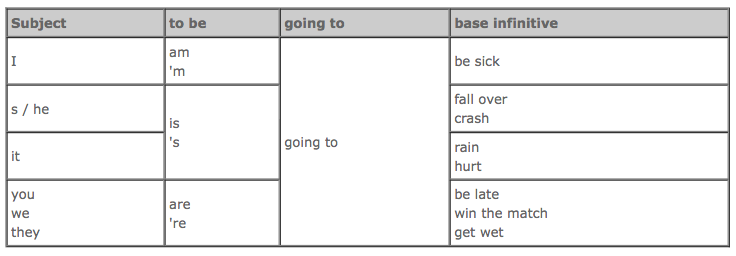
Today we're going to learn how to talk about our plans and predictions for the future with the expression be going to + infinitive. We use be going to when we are sure that something is going to happen, and we have present evidence: 
My sister is going to have a baby.I don't feel well. I'm going to be sick.Look at those clouds! It's going to rain!
Have a look at this complete explanation from BBC Learning English:

Predictions with be going to.pdf by AnaBueno_LearnEnglish


Remember that the verb be changes according to the person:


Finally, here you have some links to practise all this :)
Read more...

26 Sept 2014

How much / many?; some / any

Hello everybody!!

How are you? I hope you are enjoying the weekend!

Today we're going to talk about the difference between some words that are normally difficult for Spanish learners:
  • Much / Many
  • Too much / Too many
  • How much...? How many...?
  • Some / any
Much and many are used for quantities, and they mean "a lot of". The only difference is that much is used for uncountable nouns (always singular), and many for countable nouns (always in plural after many):
I don't want much sugar in my coffee.
There are many children playing in the street.

If there is more than we would like, we use the expressions too much / too many
There is too much noise in this room. I can't sleep.
There are too many students in the class.
And to ask about quantities, we have the question words how much / how many...?
How much water do you drink every day?
How many sandwiches do you want today?
As you can see, much is always followed by uncountable nouns, and many, by countable nouns.

Check this video to revise this a little bit more:


You can do this exercise to practise the difference between how much / how many.


Finally, both for countable and uncountable nouns you can also use some or any. Which one do you use? It depends if the sentence is affirmative (some), negative or interrogative (any).


Click if you need more information about some and any. Finally, you can practise here and here!

Happy learning!!
Read more...

2 Apr 2011

The Simpsons

Hello guys!

How's the weekend going? :)

I hope you are all more relaxed after the exams and receiving your marks (notas)! I'm very happy with the results, but I'm sure we'll all do even better in June :)

Last week we started talking about neighbours, and we watched an episode from the Simpsons: "The Lemon of Troy" (season 6, episode 24). If you want to watch it again, you can download it here. And click here for the subtitles in English.

On Wednesday we went to a theatre play by Andrew Marshall. Could you more or less understand him? And did you like it? I think we all had great fun seeing him dance and doing his work-out!!

Read more...

12 Mar 2011

Irregular verbs (downloadable pdf)

Hello everybody! :)

Last week we finished unit 5 correcting some revision exercises and having a look at the list of irregular verbs I gave you. I post it here in case you don't have it.

Irregular_verbs.pdf by ana_uk877884

Los verbos irregulares tienen la dificultad de que tienen que aprenderse de memoria, pero, como vimos en clase, no son tan irregulares como parecen: muchos de ellos pueden clasificarse en grupos que presentan exactamente la misma irregularidad tanto en ortografía como en pronunciación. Veréis cómo os resulta mucho más fácil aprendéroslos así.

On Wednesday / Tuesday we started Unit 6, and we learnt a lot of useful vocabulary about houses and rooms in a house. Then we listened to a couple visiting a house: there was something "strange" with one of the bedrooms, but they decided to rent the house! Finally, we learnt the structure there is (+sing) / there are (+plural).

With Basic Level E we had time to see a photocopy about prepositions; Basic Level D did a dialogue in a gift shop (page 60).

Next week we'll continue with Unit 6, and we'll revise for the exam.

Have a nice weekend! :)
Read more...

5 Mar 2011

The past simple / -ed pronunciation

Good afternoon everyone,

I'm sorry I didn't update (actualizar) the blog last week, but I didn't have Internet access during the bank holiday... So here you have the summary of weeks 21 and 22!

First of all, we talked about travelling, and we read a story of two friends who wanted to fly to Sydney, Canada, but they arrived in a different place...! We also listened to a couple filling out a complaint form because their holidays were not good. In fact (de hecho), they were awful!

About grammar, we saw the past simple of the verb to be, regular and irregular verbs. Click here for a very complete and clear explanation of the past simple. We did a lot of practise, but here you have some more. You can do all the exercises, or select the most interesting for you:
Remember that in regular verbs, the pronunciation of the -ed is very important. Raquel Marín, from Basic Level E, gave me this link (thank you). I hope it helps you!

We also read and listened to the stories of three girls that had a night out in Moscow, Beijing and Rio. Was your last night out similar to theirs? Would you like to post a comment telling us about your last night out?? :)

Finally, last Wednesday/Thursday we read a story about a murder... Can you remember who the murderer was?? I still can't believe it!! Then, in Basic Level D we played a very funny game called "Alibi". Basic Level E will play it next week!!

I hope you have a great weekend!
Ana.
Read more...

13 Feb 2011

/i/ vs. /i:/; possessive adjectives & pronouns; at a clothes shop

Good morning (almost afternoon!)

As usual, here you have a summary of last week:

On Monday / Tuesday we continued talking about films and you read your summaries (which were very good!!). Then we did an exercise on pronunciation to learn the difference between /i/ and /i:/. For some of you this exercise was a bit difficult, so click here if you want to practise a little bit more.

About grammar, we revised object pronouns and we learnt possessive pronouns. We worked with a photocopy to revise how to express possession in English: possessive 's, possessive adjectives and possessive pronouns. Click here and here to do some more activities related to this. Remember to visit New English File online too and to complete the workbook :)

On Wednesday / Thursday we listened to two film critics talking about 5 different films. I know it was a bit difficult, but you did very well! So... congratulations!! :) We also learnt expressions to use in a clothes shop. Click here if you want to revise this.

Remember to bring the book England to class on Monday / Tuesday. Thank you.
Read more...

6 Feb 2011

Consonant sounds; clothes; songs

Hello guys!

Last week we talked about the differences between men and women related to shopping and we learnt the pronunciation of the sound /ŋ/ - click here to revise some of the consonants we know. We learnt vocabulary about clothes and how to say what we are wearing. You can revise clothes here.

On Wednesday / Thursday we started to talk about films. We read a summary of the film Ghost, and we learnt "object pronouns", which are used to substitute nouns and after prepositions. Revise Grammar Bank 4C and practise with the Workbook.

Por último, dejo aquí tres canciones con un enlace al videoclip subtítulado y actividades para hacer online. Elegid la que más os guste, o haced las tres! :)

  • "1973", by James Blunt
Read more...

30 Jan 2011

"Can"

Hello everybody,

Last week we corrected the First Term Revision and we started Unit 4. On Monday / Tuesday, we talked about things we can do and things we can't do; we talked about our abilities.
  • I can swim
  • I can drive a car
  • I can't take good photos
  • I can't play the guitar
We also learnt that can and can't also mean possibility (I can go to your party on Saturday; I can't go to Madrid at the weekend) and permission (Can you open the window, please? Can you come here a minute?)

Click here for an online exercise with the verb can.

Read more...

23 Dec 2010

Merry Christmas to all!! Digital story of the Nativity

I post this entry to wish you all a very Merry Christmas and a Happy New Year.

Espero que aprovechéis al máximo estos días y encontréis tiempo para descansar, pasar tiempo con la familia y amigos, viajar y empezar el nuevo año con energías renovadas.


I guess (and hope!) you all know the history of Christmas. I found a digital version of the story on the Internet and I wanted to share it with you. It's so good! I hope you enjoy it!

Read more...

Listening ("Christmas is coming")

Hi everyone,

This week we only had one day of class: Monday 20th. We talked about Christmas and we saw the history of Father Christmas and Santa Claus. Then we listened to a conversation between a dad and his two children, a daughter and a son. They talked about Christmas presents and Santa Claus.

Click here to listen to their conversation again. Then do the activities below (at the end of the document you have the answers):
Christmas is coming


Read more...

19 Dec 2010

Cardinal and ordinal numbers; prepositions "in", "on", "at"

Hi all,

Here you have the summary of this week and the last one (we only had one day of class - Thursday 9th).

On Monday / Tuesday we talked about fascinating festivals around the world. We saw a powerpoint presentation with three pictures (la tomatina, los san fermines and las fallas). You discussed them in pairs and then we saw them together.

Then we read the text in file 3D and we learnt how to say the dates, the months and the seasons. Remember that in English we say dates with an ordinal number: today is 19th December / December 19th. When we speak we say, "today is the 19th of December" (BrE) OR today is December the 19th (AmE).

Click here for a list of cardinal and ordinal numbers with their pronunciation.

Read more...

27 Nov 2010

Some British festivities

Good afternoon!

How's the weekend going? :) Here you have the usual summary of the week.

Last week we talked about stress and we did a test to see how stressed we were. In class, some people were relaxed, but some of you are completely stressed out!!! We also revised some daily routines (please, study the Vocabulary Bank on page 147) and did some phonetic transcriptions on the board. Congratulations, you did them really well! :)

Then we read Louisa's story and we saw that she had a very stressful life. Then we listened to Simon (p. 31): his life is even more stressful!!

On Thursday we talked about the American festival of Thanksgiving, which is a very important celebration in the United States and in Canada.


Finally, we watched a video about traditional festivals in Britain. We talked about Guy Fawkes' Night (5th November), Pancake Day (sometime in February), St Valentine's Day (14th February) and Halloween (31st October). We'll continue watching it another day.

Have a nice weekend!
Read more...