LAST POSTS

Showing posts with label Advanced Level 1. Show all posts

23 Jan 2015

Videos with useful phrases according to your level!

Hi there!

Today I wanted to share with you a very useful section within the Inside Out website. It contains videos with useful phrases categorised into different levels: pre-intermediate, intermediate and upper-intermediate.

Here you  have the first video of the series. Scroll down and continue watching more videos which correspond to your level. I'm sure you can all understand a lot!


I also take advantage of this entry to recommend you another incredibly useful website to do listening at home (audio this time, not video, I'm afraid). It is listed in the resources I recommend for listening (make sure you check that section! --> resources online > skills > listening).

The website is www.esl-lab.com, and all the listenings are divided into different levels. You can choose the type of activity you want (open questions; multiple-choice questions or filling the gaps), and you have the transcription as well. Very useful!! :)


I hope you start using these websites!
Read more...

10 Dec 2014

"If" or "whether": what's the difference?


Whether or ifHi there!

Today I post a grammar lesson on the difference between if and whether. These two words normally pose problems for English students, since the translation into Spanish is the same in both cases (si). Here I'll post an explanation on when to use each. Hope it helps!

In very general terms, we use if in conditional sentences and whether to show that two alternatives are possible. In the cases where both are possible, whether is understood as more formal.

That said, let us look at both conjunctions in some deeper detail:

If and whether are interchangeable in the following contexts:

  • IN REPORTED OR INDIRECT YES/NO QUESTIONS:
She asked if / whether I'd be attending the party.
Do you know if / whether dinner will be ready soon?
I don't know if / whether she's coming or not.
  • "WHETHER / IF ... OR ... " CONSTRUCTIONS
I'd really like to know whether / if he's lying or telling the truth.


Use ONLY whether in the following contexts:

  • TO PRESENT TWO ALTERNATIVES:
Let the principal know whether you'll attend the meeting
(there are two alternatives: you'll attend the meeting or you won't. You have to inform the principal in either case).

Let the principal know if you'll attend the meeting
(this sentence is grammatically correct, but the meaning is different. In this example, the principal is only be told if you'll attend the meeting. Therefore, if you'll attend the meeting is a condition, it doesn't present two alternatives).
  • AFTER PREPOSITIONS:
My final decision depends on whether you agree (on if)
I would like to talk to you about whether you'll continue working here (about if)
  • BEFORE INFINITIVES:
I've been thinking whether to quit my job (if to quit)
She can't make up her mind whether to marry him (if to marry him).
  • DIRECTLY BEFORE OR NOT:
Please, tell me whether or not you agree (if or not)

(Note that or not can be placed at the end of the sentence. In that case, if is possible: Please, tell me if you agree or not).
  • WHEN WHETHER STARTS A CLAUSE:
Whether she liked the present, I don't know.
Whether he comes or not is nor my concern.
I don't care whether you study or waste your time.

(If we use if in these contexts it would be understood as a condition)
  • WHEN WHETHER EXPLAINS SOMETHING THAT COMES BEFORE:
You have to answer my question, whether I can count on you (that is my question).


Use ONLY if in the following contexts:

  • TO INTRODUCE A CONDITION:

If I had the chance I would travel all around the world.
If it hadn't been for my family, I wouldn't have got so far.

YOUR TURN! :)

Now check how much you can remember with the following exercises!


Read more...

28 Nov 2014

Exam practice B2 level (I)

Hi!
Level B2

The exams are coming closer and I wanted to give you some exam practice to get ready!

These exams are all taken from the First Certificate in English Exam from Cambridge, which roughly corresponds to a level B2:

READING

USE OF ENGLISH

LISTENING

Good luck! :)
Read more...

24 Nov 2014

Learn how to be more descriptive!

Hi there!

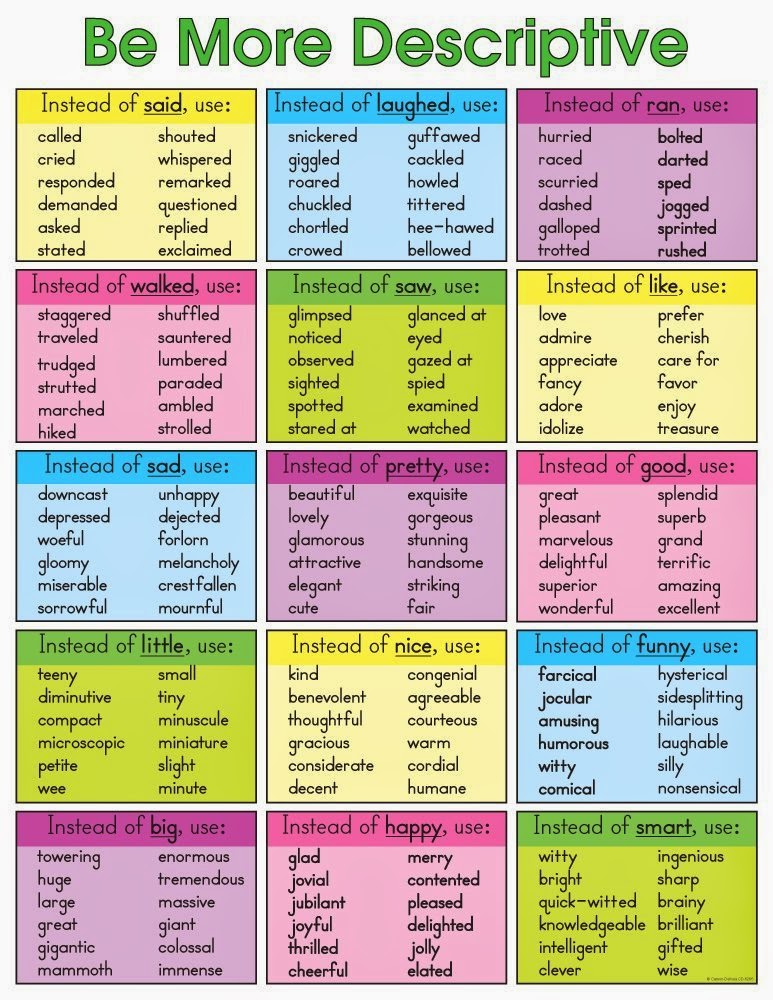
I'm sure you've all heard your teachers asking you to use more complex vocabulary, and avoid using words like nice, good, say, ask, etc. Indeed, as we advance in our language learning, we have to be more specific and avoid 'empty words' like the ones I mentioned before.

How can we do that? A very good idea is to compile a list of synonym words and include some linguistic variation when we talk/write. Here I post an example: 

My suggestion is that, for every word, you choose two or three synonyms that you've never used before. Circle/underline them and make an effort to use them in the next few weeks. That way you'll enrich your vocabulary little by little!

Let me know how it goes! :)
Read more...

19 Nov 2014

Improve your conversations in English!

Hi everyone!
Oral interaction

Today we're going to focus on speaking and, more specifically, on interaction!

As you know, a language is, above all, a vehicle to communicate with other people. That means that we need to know phrases to express our opinion and ask for theirs, agree or disagree with what they say, ask them to repeat, show interest, etc.

Knowing how to interact is an essential part of our speaking skills in a foreign language. Responding to what other people say and being able to engage them in conversation is of paramount importance. However, explicit training on this issue is sometimes overlooked (pasado por alto) in our language classrooms...

For this reason I have done a compilation of useful phrases that you can use at different levels. Start using them in your conversations in class and you'll see how little by little your communication becomes a lot more natural and fluent!

If you find this useful, please feel to share on your social networks!

Basic Levels 1 and 2


Intermediate Level


Advanced Levels 1 and 2


C1


Read more...

17 Nov 2014

"Bed and breakfast", "fish and chips" and other binomial expressions

A binomial is a combination of two words, normally linked by a conjunction (and or or). Their order is almost always fixed, that is, they are irreversible.

English is extremely fond of binomials, and when I say "extremely", I do mean "extremely"!  If you want to check for yourselves, have a look at this list of binomials, with their corresponding meanings. You'll be surprised!

Do these ones ring a bell??


Some other common ones include:


If you want to know a few more, check the video below: "10 common binomial expressions in English". She speaks rather slowly, but her explanations and examples are very accurate!


Finally, for more advanced learners, here I post a handout with some more complex ones. See if you can complete the exercises! (The answers are at the end, as usual!)


Now, the best way to remember binomials, as every other item of vocabulary, is to place them in context. Choose your favourite ones and post a few examples in the comments below!
Read more...

3 Nov 2014

Stop sounding like a book!

Hi there!

Today I'm going to post some useful expressions that will help you sound a lot more natural in English!

They're mainly short comments to continue the conversation and respond to what the other person said. Things like ya te digo; ¡ni de broma!; me lo dices o me lo cuentas; lo que tú digas, etc.

Useful, right? Check them out!


Had you heard any of these expressions before? Check their meaning in a dictionary or at www.linguee.es. Then practise with this online exercise from the Yes! Magazine. After that, why don't you write a short dialogue with as many expressions as you can?

Enjoy!! :)

Read more...

27 Oct 2014

The police is... or are? - Singular and plural invariable nouns

Hi there!
Invariable nouns

The other day in class some of you asked me about nouns which are always singular, and nouns which are always plural. This is important for the ageement (concordancia) with the verb and pronouns.

Well, here you have a complete list of those nouns!

Nouns which are always singular (singular invariable nouns)
  • Proper nouns, e.g. Sally, Bruce, Jamie.
  • Uncountable nouns. If we want to count them, we have three options:
     1. Measures: one pound of butter; two litres of milk; three kilos of sugar...  

     2. Partitives: a piece of, a bit of, an item of... 

     3. Specific counters: a flash of lighting; a word of advice; a burst of applause...
  • Some nouns ending in -s
               1. News

               2. Subjects and sciences which finish in -ics: linguistics, politics, phonetics...

               3. Some games: billiards, draughts, darts, dominoes...

               4. Certain diseases: measles, mumps, rickets, shingles...
  • Collective nouns, which refer to groups of single entities. The verb can be either singular or plural; the decision depends on whether the speaker is thinking of the group of a whole or as a collection of individuals:
               Government, team, company, council, committee...

Nouns which are always plural (plural invariable nouns)
  • Tools, instruments and articles of clothing which consist of two parts joined together: glasses, scissors, binoculars, spectacles, trousers, jeans, trunks, tights, shorts...
  • Nouns that refer to entities which comprise an indefinite number of parts: clothes, outskirts, stairs, surroundings, goods, remains...
  • Some proper nouns: the Netherlands or the States
  • Nouns that do not have an -s, but are plural anyway: police, people, staff, clergy, folk, cattle, poultry, livestock
Useful? :)
Read more...

17 Oct 2014

Urban legends

Hi there!
Urban legends
Today we are going to talk about urban legends, which are a form of modern folklore made up of stories whose truth is doubtful, but which nonetheless spread like wildfire!


In the document below you have several urban legends taken from www.snopes.com (this website is ideal if you want to check if a spreading rumour is true or not!!). Take some time to think whether you believe these stories, and then check clicking on the link at the bottom of the page!


Once you read that, take some time to watch this video about the 25 most popular urban legends still being told!


Are there any urban legends famous in your area? Please share them in a comment! :)
Read more...

4 Nov 2013

Health; going to the doctor's; good stress; present perfect simple vs. continuous

Hi there!

These days we've been talking about health and eating habits. In one of the first sessions we discussed whether milk was good for the body or not . Here I post the video in case you may want to watch it again. If you open it directly on YouTube remember that you can activate subtitles. However, remember that they are computer-generated, so you may find many mistakes. Still, they are still helpful to follow the main ideas.


Read more...

10 Oct 2013

Revision of tenses; personality adjectives; relationships

Hi everyone!

Here you have the first entry of the year! I'll regularly post a summary of what we've done in class but, most importantly, I'll also post extra material to consolidate and to expand what we do in the lessons.

We've already advanced quite a lot and are almost finishing Unit 1! These days we've been revising tenses, question formation and auxiliaries. As for vocabulary, we've talked about relationships and also personality.

If you want to continue revising English tenses, try the following exercises online:

  • Revision of tenses 1: here you have exercises with pairs of tenses (present simple vs. present continuous; past simple vs. past continuous; past simple vs. past perfect, etc).
Read more...

18 Apr 2013

Infinitive or -ing?

Many of you still have problems with verbs followed by infinitive or -ing.

Click here for a revision and here to do an activity online.
Read more...

11 Feb 2013

Negative prefixes; why men & women can't be friends

Hi everyone,


On Wednesday we worked with negative prefixes (prefixes to form opposite words). These prefixes can be a bit difficult because there is no rule that tells us which prefix we have to use. For example, is it inexpensive or inexpensive?

That means that we have to learn them by heart...!

Here you have the most common negative prefixes, with some examples:

Dis- 

Negative prefixes


Un-
Negative prefixes


In-
Negative prefixes

Il- (always used with words that begin with <l>)


Negative prefixes


Im- (always used with words that begin with <p>)


Negative prefixes


Ir- (always used with words that begin with <r>)

Negative prefixes

You can revise this a little bit more on this link from BBC World Service. If what you want is practise, here you have a matching exercise and a multiple choice exercise(Note that the adjective "satisfied" can have to opposites: "unsatisfied" and "dissatisfied").

Now, changing topic...! The day we saw negative prefixes in class we also discussed some issues about family and friends, and someone asked if you believed that boys and girls could be friends, and just friends.

Well, I've found a video recorded at Utah State University about this topic ("Why men and women cannot be friends"). It's in English with subtitles in Spanish, so check it out! I'm sure you'll find it very funny :)

Read more...

23 Nov 2012

FCE Test Practice ONLINE! :)

Hi again,

Looking for materials that some people from 5º CAL had asked me for, especially reading, I have come across a website with several real FCE tests that you can do online (awesome!!).

Because there's quite a lot of material there and I don't want you to feel overwhelmed, I'll regularly make a selection of tests for you to do during the week/weekend, or whenever you manage to put some time aside. Here you have three of them.

Read more...

26 May 2012

Cultural differences; animated history of Coca-Cola

Hi everyone!

In these last two weeks we've worked with the book, but especially with photocopies. Make sure you revise the vocabulary and grammar carefully.

Last Friday we had class and we watched a video about cultural differences among countries as regards handshaking and other body language. I've just found a video by National Geographic where a group of Africans travel to the United States... You can imagine the cultural shock! Watch the video and you'll see (most of it is subtitled as the African accent is extremely strong):

Read more...

13 May 2012

My Sister's Keeper; cloning food

Hi everyone!

I hope you've had a nice weekend! It's been scorching hot, so maybe some of you have already started to enjoy the beach! :)


On Tuesday we started talking about some questions related with science and then we discussed some moral dilemmas. One of them had to do with modifying embryos so that the born child would be compatible with his/her brother/sister. This reminded me of the film "My sister's keeper" (2009), a film I thoroughly recommend. I post the trailer below for you to decide whether you want to watch it or not!


Read more...

5 May 2012

Conditionals; crime; Jack the Ripper

Hi everyone!

I hope your weekend is off to a good start (nice expression to learn!), although the weather is absolutely miserable!! Let's hope this howling wind goes away soon!

Last week we corrected the unit about "The Natural World". It's a lot of vocabulary, I know, but, remember, take things calmly: sit down, select the words you don't know, copy them in your notebook and check them regularly.

Read more...

13 Apr 2012

Ku Klux Klan; learning styles; extreme weather conditions

Hi everyone!

This week we've started the 3rd term... Hope you're all eager to start your engines! Only the last months remaining in front of us :)

On Tuesday you told me a bit about your Easter holidays and then we talked about how foreigners, especially those coming from the States, see our Semana Santa. We read a short text about the Ku Klux Klan and we also watched a National Geographic video (original link here). I post it below, with the activities and the corresponding answers.

Read more...

17 Feb 2012

Ways to look; "Falling slowly" (song)

Hello everyone!

Last week we did an interesting photocopy with idioms of comparison (e.g. as fresh as a daisy; as deaf as a post; as blind as a bat, as hard as nails, etc.). Make sure you revise this vocabulary!

We also did a little game in pairs to revise some of the phrasal verbs we have seen so far. As a word of advice, have a separate section for phrasal verbs in your notebook. Apart from the translation (if you use translations), try to think of another synonym verb (e.g. give in - surrender) and always, always include a example to see the phrasal verb in context.

We also continued with the book and corrected the exercises on pages 68 and 69. The one about "ways to look" was a little complicated, so I gave you a handout with their explanations.


Read more...

6 Feb 2012

Verb + -ing; English cream tea; creatures in the ocean

Good morning!

Last week we started talking about the ideas we have of different countries (stereotypes) and we saw that more often than not they are overgeneralisations that do not correspond to reality. You worked in groups and thought about the stereotypes we have of the British, the Americans, the Germans and the Spanish. Then we worked with a text called "What every visitor to England should know".

After that, we learnt the different uses of the -ing form of the verb and we practised with several exercises:

Uses of verb in -ing


Read more...