LAST POSTS

Showing posts with label Grammar. Show all posts

20 Jan 2015

The present perfect and typically related words (ever, never; for, since; just, yet, already)

Hi everyone!

Today we're going to focus on the present perfect tense and, more specifically, several words that are typically associated with it -although in future years you will see that they can be used in other tenses as well!

First of all, let us very quickly revise when we use the present perfect, especially in contrast with the past simple:


To cut a long story short (en resumidas cuentas), use the present perfect:

  • For life experiences (they are finished, they happened in the past, but I don't know when)
It is in this context that we typically use ever and never:
Have you ever swum with dolphins?; Have you ever tried bungee-jumping? 
I've never eaten Viatnamese food.
If you want to practise a little bit, complete this information about Loch Ness.
  • For actions that started in the past and still continue now.
It is in this context that we typically use the words for and since.


If you would like to have more information about for and since, click for a detailed explanation with plenty of examples that you can also listen to. If what you need is practice, click below:

Finally, there are three other words that are normally used in the present perfect: just, already and yet. Read the information below to understand their meaning and their position in the sentence.
  • We use just for something that has very recently happened (acabar de). We place it in the middle of the sentence, between have and the participle:
I've just learnt how to use for and since.
I've just been to the supermarket.
  • We use already in affirmative sentences to mean 'sooner than expected'. We generally place it between have and the participle, but it can also appear at the end of the sentence:
I've already finished reading Dracula / I've finished reading Dracula already.
I've already been to London three times / I've been to London three times already.
  • We use yet in negative and interrogative sentences. We place it at the end of the sentence:
I haven't started Sherlock Holmes yet.
Have you been to England yet?
  • BUT remember: we can also use already in questions when we expect a positive answer
Have you already started revising for the exam?

And now comes the practice!

To finish today's entry, here you have two websites to practise some of the grammar we have seen already :)
Remember that revising is even more important than studying something for the first time! :)
Read more...

10 Dec 2014

"If" or "whether": what's the difference?


Whether or ifHi there!

Today I post a grammar lesson on the difference between if and whether. These two words normally pose problems for English students, since the translation into Spanish is the same in both cases (si). Here I'll post an explanation on when to use each. Hope it helps!

In very general terms, we use if in conditional sentences and whether to show that two alternatives are possible. In the cases where both are possible, whether is understood as more formal.

That said, let us look at both conjunctions in some deeper detail:

If and whether are interchangeable in the following contexts:

  • IN REPORTED OR INDIRECT YES/NO QUESTIONS:
She asked if / whether I'd be attending the party.
Do you know if / whether dinner will be ready soon?
I don't know if / whether she's coming or not.
  • "WHETHER / IF ... OR ... " CONSTRUCTIONS
I'd really like to know whether / if he's lying or telling the truth.


Use ONLY whether in the following contexts:

  • TO PRESENT TWO ALTERNATIVES:
Let the principal know whether you'll attend the meeting
(there are two alternatives: you'll attend the meeting or you won't. You have to inform the principal in either case).

Let the principal know if you'll attend the meeting
(this sentence is grammatically correct, but the meaning is different. In this example, the principal is only be told if you'll attend the meeting. Therefore, if you'll attend the meeting is a condition, it doesn't present two alternatives).
  • AFTER PREPOSITIONS:
My final decision depends on whether you agree (on if)
I would like to talk to you about whether you'll continue working here (about if)
  • BEFORE INFINITIVES:
I've been thinking whether to quit my job (if to quit)
She can't make up her mind whether to marry him (if to marry him).
  • DIRECTLY BEFORE OR NOT:
Please, tell me whether or not you agree (if or not)

(Note that or not can be placed at the end of the sentence. In that case, if is possible: Please, tell me if you agree or not).
  • WHEN WHETHER STARTS A CLAUSE:
Whether she liked the present, I don't know.
Whether he comes or not is nor my concern.
I don't care whether you study or waste your time.

(If we use if in these contexts it would be understood as a condition)
  • WHEN WHETHER EXPLAINS SOMETHING THAT COMES BEFORE:
You have to answer my question, whether I can count on you (that is my question).


Use ONLY if in the following contexts:

  • TO INTRODUCE A CONDITION:

If I had the chance I would travel all around the world.
If it hadn't been for my family, I wouldn't have got so far.

YOUR TURN! :)

Now check how much you can remember with the following exercises!


Read more...

27 Oct 2014

The police is... or are? - Singular and plural invariable nouns

Hi there!
Invariable nouns

The other day in class some of you asked me about nouns which are always singular, and nouns which are always plural. This is important for the ageement (concordancia) with the verb and pronouns.

Well, here you have a complete list of those nouns!

Nouns which are always singular (singular invariable nouns)
  • Proper nouns, e.g. Sally, Bruce, Jamie.
  • Uncountable nouns. If we want to count them, we have three options:
     1. Measures: one pound of butter; two litres of milk; three kilos of sugar...  

     2. Partitives: a piece of, a bit of, an item of... 

     3. Specific counters: a flash of lighting; a word of advice; a burst of applause...
  • Some nouns ending in -s
               1. News

               2. Subjects and sciences which finish in -ics: linguistics, politics, phonetics...

               3. Some games: billiards, draughts, darts, dominoes...

               4. Certain diseases: measles, mumps, rickets, shingles...
  • Collective nouns, which refer to groups of single entities. The verb can be either singular or plural; the decision depends on whether the speaker is thinking of the group of a whole or as a collection of individuals:
               Government, team, company, council, committee...

Nouns which are always plural (plural invariable nouns)
  • Tools, instruments and articles of clothing which consist of two parts joined together: glasses, scissors, binoculars, spectacles, trousers, jeans, trunks, tights, shorts...
  • Nouns that refer to entities which comprise an indefinite number of parts: clothes, outskirts, stairs, surroundings, goods, remains...
  • Some proper nouns: the Netherlands or the States
  • Nouns that do not have an -s, but are plural anyway: police, people, staff, clergy, folk, cattle, poultry, livestock
Useful? :)
Read more...

26 Oct 2014

Comparatives and superlatives

Hello everyone!

Today I write about comparatives and superlatives!

Here I leave you with a powerpoint presentation with the basics of how you form comparatives and superlatives in English. I hope you find it useful!


How do we choose between adjective + -er/-est or more/the most? It depends on the number of syllables!
  • Suffix -er/-est: for 1 syllable adjectives, and 2 syllable adjectives that end in -y (for example, happy, easy).
  • More / the most: for the rest of adjectives.
Here you have a few examples of the different types of comparatives:

+


-


=


If you need to revise a little bit, here you have an explanation in Spanish. Finally, to practise a little bit, do this exercise on comparatives and superlatives (you can select 4 levels of difficulty). And here you have a text about London and another one about Los Angeles, with a grammar exercise at the end.

Enjoy!

Read more...

22 Oct 2014

"Near" or "nearby"...?

Hi there!

Today I'm going to talk about the difference between the words near and nearby. Their meaning is very similar; the difference is how they are used in the sentence.

NEAR can be a preposition or an adverb. As a preposition, it is followed by a complement:
I live near the museumThere is a supermarket near here.

As an adverb, near appears at the end of the sentence:
near nearby
The next bus stop is quite near.

She's getting nervous because her wedding is very near!

NEARBY, on the contrary, is an adjective, and it can appear before and after a noun.

There is a nearby church.
The nearby town is famous for its wine.
There is a park nearby.


Nearby can also appear "alone", but it is still an adjective: the shop is nearby/very expensive. Or an adverb! I live nearby (= I live near here)


Finally, here I post a video of a teacher explaining all this (remember that you can activate the subtitles!):

Read more...

20 Oct 2014

Emphatic structures (1): Cleft and pseudo-cleft sentences

Cleft sentence
Hi there!


Today we are going to be concerned with emphatic structures. English offers many different ways to give prominence to specific parts of the sentence and we'll explore all of them little by little.


In this entry we are going to focus on cleft and pseudo-cleft sentences, which allow us to emphasize different parts of the sentence by dividing it into two parts (these two parts will be marked with a double slash // )


Cleft sentences are formed with it is/it was + emphasized element + relative clause. Different parts of the sentence can be emphasised in this way:

1.     Dave lent me his car last week.
a.     It was Dave  // who/that lent me his car last week.
b.     It was his car  //  that/which Dave lent me last week.
c.     It was last week  //  that/when Dave lent me his car.

We can also find examples with because:
It was because he was angry  // that he didn't come to the cinema.
Pseudo-cleft sentences are introduced by what and the emphasis is postponed to the end (in cleft-sentences the emphasis is at the beginning):
Dave lent me his car last night --> What Dave lent me last night  //  was his car. 
I love rainy days --> What I love  //  are rainy days. 
You need a rest --> What you need  //  is a rest.
We can also emphasise events using the auxiliaries do/did:
Peter forgot his keys at the cinema --> What Peter did  //  was (to) forget his keys at the cinema.
We are destroying our planet --> What we are doing   //  is (to) destroy our planet.
Last but not least, we can also start a sentence with all to mean "the only thing".
I only need you --> All I need  //  is you

If you need more information, click on the following links on cleft sentences and pseudo-cleft sentences.

Finally, download the following document if you want some practise! (The answers are at the end of the document).


Read more...

7 Oct 2014

Can you use the word "indeed"? Indeed I can!


B2, C1

In yesterday’s class we discussed the possible uses and meanings of the word indeed, which can be a bit tricky to translate. Some of you suggested it was synonymous with “in fact”, although in some cases it can also mean something like “certainly”, “very” or it can even be used to express surprise - “you’re telling me!” (¡no me digas!).


To start with, the word indeed originates from the Latin phrase in dede, which meant “in truth”. This meaning can clearly be seen in all of the following four uses:
  • When it is used after very + an adjective/adverb, it has a clearly emphatic meaning: 
Thank you very much indeed.
I was very happy indeed to hear about your results!
  • It can be used to emphasize a positive statement or answer:
That is indeed the person I was talking about.
They are indeed braver than most people.
‘Was he very upset?’ ‘Indeed he was!’
‘Do you agree?’ ‘Yes, indeed.’
  • At the beginning of a sentence, it is used to complete or add information to a statement. In other words, indeed provides emphasis or indicates that the sentence is evidence/an example of what was said previously.
Yes, I passed the exam. Indeed, I got the highest mark in the whole class.

You don’t have to thank me. Indeed, I am delighted to help.

The economic crisis has a negative influence on how much we spend. Indeed, foreign investments have never been as low.
  • As an interjection, indeed indicates surprise or sarcastic doubt. In this use, indeed is often the only word in the sentence.
"He thinks she'll marry him??" "Indeed!" (¡Vaya si lo piensa!)

I hope you now have a clearer idea of how to use the word indeed! If you still have any questions or doubts, or simply want to say how useful you found this entry, feel free to post a comment below!

Read more...

1 Oct 2014

"Be going to" for predictions

Hello everyone!

How is the weekend? :)

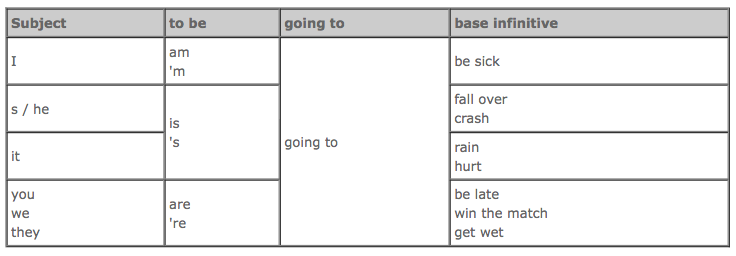
Today we're going to learn how to talk about our plans and predictions for the future with the expression be going to + infinitive. We use be going to when we are sure that something is going to happen, and we have present evidence: 
My sister is going to have a baby.I don't feel well. I'm going to be sick.Look at those clouds! It's going to rain!
Have a look at this complete explanation from BBC Learning English:

Predictions with be going to.pdf by AnaBueno_LearnEnglish


Remember that the verb be changes according to the person:


Finally, here you have some links to practise all this :)
Read more...

30 Sept 2014

Saxon genitive ('s) or of + noun?

B2, C1

"Saxon genitive ('s) or of + noun?... that is the question."

Choosing between the Saxon Genitive ('s) or the structure "of + noun" can sometimes be difficult. Below I include all the factors that influence the choice. I'm sorry if the explanation is a bit too technical, but it's the only one there is...


To start with, it is important to note that there are lexical, syntactic, communicative and relational factors influencing the choice between the Saxon genitive and a prepositional phrase (of).

  • Lexical factor (related to vocabulary)
When the possessor is a person, the genitive is preferred, e.g. John's boat.
  • Syntactic factor (related to grammar)
If the noun has a very long modifier, we prefer the of-construction, e.g.
The answer of the student who was sitting next to the window
(NOT The student who was sitting next to the window's answer).
  • Communicative factor, depending on where we want to lay emphasis:
The world's economy --> emphasis on economy.
The economy of the world --> emphasis on the world.
  • Relational factor (related to the relation between the words)
- Partitive meaning: the of-construction is preferred --> A glass of water; a pint of beer

- Object relation: it favours the of-construction: The imprisonment of the murderer  (they put the murderer in prison - object)


- In subject relations both are equally used: the arrival of the train / the train's arrival (the train arrived - subject).


Well, I hope this explanation has been useful!


If you have any questions or comments, please leave them below!

Read more...

26 Sept 2014

How much / many?; some / any

Hello everybody!!

How are you? I hope you are enjoying the weekend!

Today we're going to talk about the difference between some words that are normally difficult for Spanish learners:
  • Much / Many
  • Too much / Too many
  • How much...? How many...?
  • Some / any
Much and many are used for quantities, and they mean "a lot of". The only difference is that much is used for uncountable nouns (always singular), and many for countable nouns (always in plural after many):
I don't want much sugar in my coffee.
There are many children playing in the street.

If there is more than we would like, we use the expressions too much / too many
There is too much noise in this room. I can't sleep.
There are too many students in the class.
And to ask about quantities, we have the question words how much / how many...?
How much water do you drink every day?
How many sandwiches do you want today?
As you can see, much is always followed by uncountable nouns, and many, by countable nouns.

Check this video to revise this a little bit more:


You can do this exercise to practise the difference between how much / how many.


Finally, both for countable and uncountable nouns you can also use some or any. Which one do you use? It depends if the sentence is affirmative (some), negative or interrogative (any).


Click if you need more information about some and any. Finally, you can practise here and here!

Happy learning!!
Read more...

4 Nov 2013

Health; going to the doctor's; good stress; present perfect simple vs. continuous

Hi there!

These days we've been talking about health and eating habits. In one of the first sessions we discussed whether milk was good for the body or not . Here I post the video in case you may want to watch it again. If you open it directly on YouTube remember that you can activate subtitles. However, remember that they are computer-generated, so you may find many mistakes. Still, they are still helpful to follow the main ideas.


Read more...

10 Oct 2013

Revision of tenses; personality adjectives; relationships

Hi everyone!

Here you have the first entry of the year! I'll regularly post a summary of what we've done in class but, most importantly, I'll also post extra material to consolidate and to expand what we do in the lessons.

We've already advanced quite a lot and are almost finishing Unit 1! These days we've been revising tenses, question formation and auxiliaries. As for vocabulary, we've talked about relationships and also personality.

If you want to continue revising English tenses, try the following exercises online:

  • Revision of tenses 1: here you have exercises with pairs of tenses (present simple vs. present continuous; past simple vs. past continuous; past simple vs. past perfect, etc).
Read more...

18 Apr 2013

Infinitive or -ing?

Many of you still have problems with verbs followed by infinitive or -ing.

Click here for a revision and here to do an activity online.
Read more...

27 Jan 2013

Introductory "it"; India; How can you tell if someone is lying?; "Imagine Dragons"

Hi everyone!

Since we came back from Christmas we've practically fully covered Unit 4, related to crime and punishment.

One of the first days we watched a video about the dramatic news of the incident occurred in India. If you wish you watch the video again to practise your listening, I post it below. Remember that you have the whole transcription, so you can check it as you listen, if necessary.

Read more...

11 Nov 2012

Work conditions; must / have to / don't have to / mustn't

Hi everyone!

How was your weekend? I hope you enjoyed it, although the weather wasn't too good!

In this entry I post a summary of what we did last week, and also some extra material you might find interesting.

On Monday we did a little bit of revision and we also started Unit 3 talking about jobs. We did an activity where you had to write a job for every letter of the alphabet. Some letters were a bit difficult, but you almost (casi) completed all the alphabet! :) We also learnt some expressions such as flexible working hours, opportunities for promotion, sick pay, holiday pay, etc. Make sure you learn them!


Read more...

3 Nov 2012

Past simple & past continuous; Halloween

Hello everyone,

In the previous entry I posted some information to revise Unit 1. Here I do the same with Unit 2!

In this unit we have talked about fast food, first meetings, love and relationships, stories and how to start and finish a conversation!

About grammar, we revised how to form the past simple and the past continuous, and when we use them. Be very careful with the pronunciation of the -ed past. The rule "PoKaSH FiCHaS Te Doy" can help!

Read more...

Subject questions; jobs; free time

Hi again!

In this entry I'm going to post some information to revise Unit 1, and then I'll do the same with Unit 2.

At the beginning of the course we did several activities to know each other (some of you met for the first time!), and in the third week you did your first oral presentations. In groups of 3, you talked about someone important from an English speaking country. Thank you once again for your truly great effort :)

Below (abajo) you have a brief summary of the main grammar and vocabulary we have seen in the unit, so that you can revise at home and do some activities on-line:

Read more...

13 May 2012

Just / already / yet; passive voice; clothes

Hi everyone!

I hope you've had a very nice weekend! :)

Last week we had the test on the book The Last Sherlock Holmes Story. I hope you enjoyed reading it. I personally found it very interesting: it is said that Sherlock Holmes was Jack the Ripper! If you want to learn a bit more about this serial killer, you can watch the film "From Hell" (2001), with Johnny Depp. In original version, of course :)

That day we also did an activity called "Can you think of...?" And you had to think about two things you could swim across, two things you could go through... etc. Make sure you revise those prepositions!!

Read more...

5 May 2012

Pronunciation of -ed ending; used to

Hello everyone!!

I hope your weekend has started well!! Although the weather is miserable... I hope the wind goes away soon! :)

In the last two weeks we've finished Unit 9, where we talked about everyday problems, problems with neighbours, adjectives of feelings, how to make invitations, etc. We also revised how to pronounce -ed at the end of words. Remember the rule:

/t/: PoKaSH FiCHaS
/id/: Te Doy
/d/: the rest


Read more...

Conditionals; crime; Jack the Ripper

Hi everyone!

I hope your weekend is off to a good start (nice expression to learn!), although the weather is absolutely miserable!! Let's hope this howling wind goes away soon!

Last week we corrected the unit about "The Natural World". It's a lot of vocabulary, I know, but, remember, take things calmly: sit down, select the words you don't know, copy them in your notebook and check them regularly.

Read more...